A request for quote, or RFQ, is a structured document you send to potential suppliers that spells out exactly what you need so they can give you an accurate price. In 3PL sourcing, it's used to replace the scattered phone calls and inconsistent email threads that make traditional warehouse shopping so slow. Instead of approaching providers one at a time, you define your requirements once and send that information to multiple warehouses simultaneously. They quote. You compare. You choose. The RFQ is what turns 3PL sourcing from a cold-call exercise into a structured, competitive process, and it's the operational mechanism that makes a 3PL marketplace genuinely different from a broker or a directory.
Getting quoted used to mean weeks of back-and-forth with providers who were each working from different information. With a 3PL marketplace like WareMatch, submitting an RFQ has never been easier: one submission, multiple qualified bids, full visibility into what each provider is offering.
Most ecommerce brands and SMBs have never issued a formal RFQ. The process feels like it belongs to large procurement teams, not a founder trying to outsource fulfillment for the first time. This piece walks through each step plainly, from both sides of the transaction, so you know exactly what to expect.
What an RFQ Actually Is
An RFQ is a formal way of telling suppliers what you need before they give you a price. The word "formal" doesn't mean complicated. It means structured enough that every provider is quoting on the same information, so you can actually compare their responses.
Procurement platforms define an RFQ as a document used to invite suppliers to provide pricing for a clearly defined product, service, or project scope. In plain terms: you tell them your volume, your requirements, your timeline, and your constraints. They tell you what they'll charge.
In 3PL sourcing, the RFQ is how you replace a dozen different phone calls and scattered email threads with one submission that goes to every qualified provider simultaneously. The WareMatch marketplace is built around this mechanism. It's what turns a directory into a competitive, transparent sourcing tool.
If you've read our earlier piece on what a 3PL marketplace is and how it differs from a broker, the RFQ is the operational piece that makes that model work. The marketplace is the infrastructure. The RFQ is what moves through it.
What You Need to Have Ready before You Submit
This is where most brands run into friction. They reach out to a 3PL without the right information, and the warehouse either can't quote or has to go back and forth three times to fill in the gaps. That wastes everyone's time and slows the process down before it even starts.
Here's what a qualified RFQ typically needs to include for 3PL sourcing:
Volume and order frequency. How many orders do you ship per month? What does your peak look like? A 3PL prices around your average volume but needs to know whether your peak is 20% above average or 300% above it. If you're doing seasonal business, that changes the kind of provider you need entirely.
SKU count and product profile. How many distinct SKUs do you carry? Are they small and lightweight, or large and heavy? Fragile? Require special handling? The more clearly you can describe your product mix, the more accurate the quote will be. Vague inputs lead to padded quotes.
Storage type and physical requirements. Does your product need racking, ambient floor storage, or shelving? Do you need clear height for tall pallets? Yard access for large inbound shipments? Climate control? Brands often overlook these details in early outreach, and they matter significantly for which warehouses can actually serve them.
Special requirements. Hazmat handling, temperature sensitivity, FBA prep compliance, lot tracking for expiry dates, or any regulatory certification your product category requires. These aren't edge cases. They eliminate entire categories of providers, and surfacing them early means you don't waste time getting a quote from a warehouse that can't handle what you ship.
Geographic needs. Where are your customers? A single fulfillment center in the wrong location can add one to two shipping zones to every order, which has a direct impact on cost and delivery speed. If you're looking for 3PL logistics in California, warehouse space in New Jersey, or any specific region where your customer base is concentrated, that geographic constraint should be explicit in your RFQ.
Target go-live date. 3PL onboarding typically runs four to eight weeks from contract signing. Providers need to know your timeline to assess whether they can take you on and meet your launch date.
The more complete your RFQ, the better quality bids you'll get back. It's a direct relationship.
What Happens after You Submit an RFQ
Once your RFQ is submitted through WareMatch, it doesn't sit in a queue waiting for a sales team to manually route it. The platform surfaces it to 3PL providers whose capabilities match your requirements, whether that's geography, storage type, certifications, or volume range.
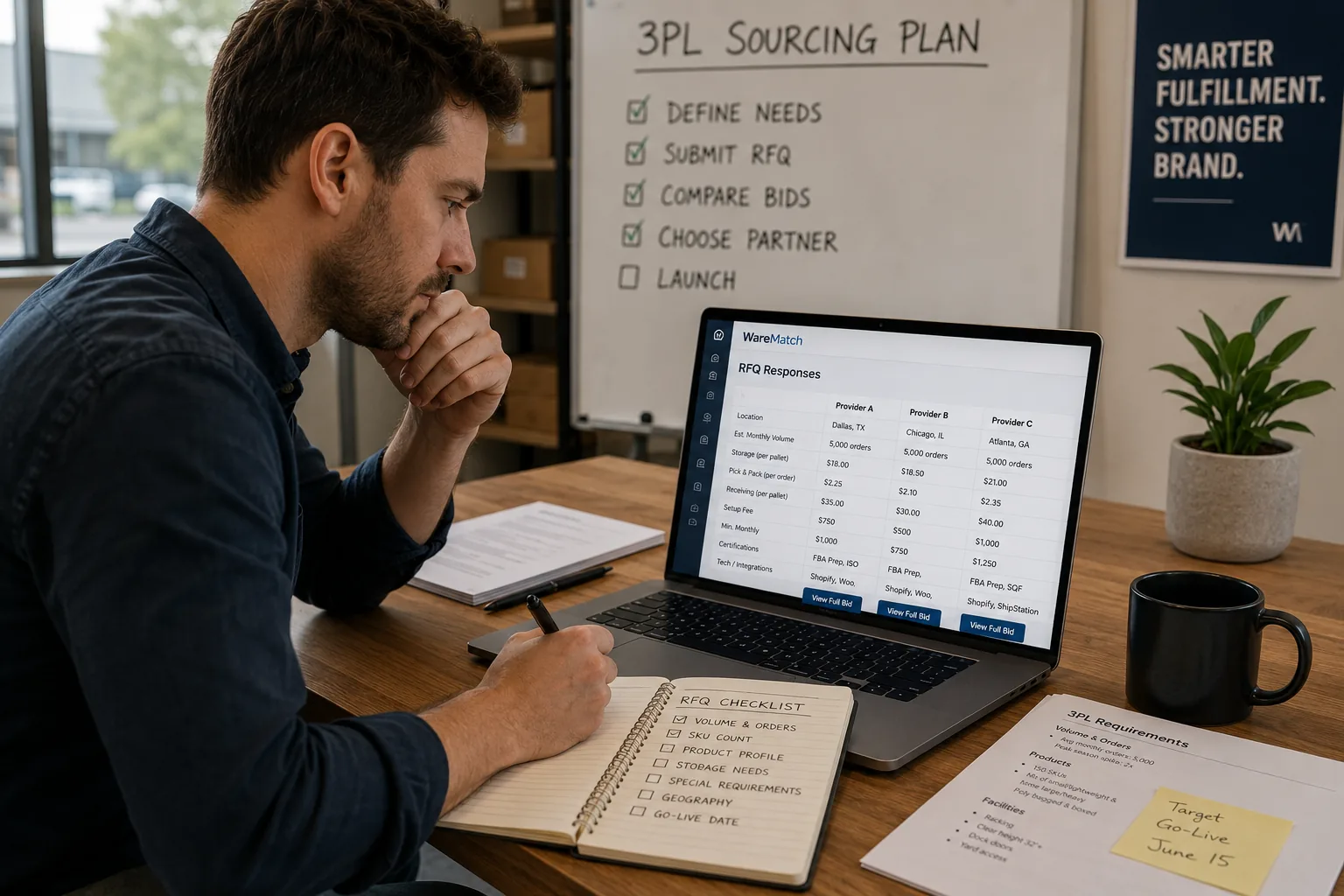
Those providers then have a defined window to respond with a bid. A bid from a 3PL typically includes their pricing structure broken down by service (receiving, storage per pallet, pick and pack per order, shipping), any setup fees, their available capacity, and relevant certifications or accreditations. Some providers will also include notes on their technology stack or integration capabilities, especially if you've flagged that you're running Shopify, WooCommerce, or another specific platform.
The bidding window creates competition by design. Because multiple warehouses are responding to the same RFQ at the same time, they know they're not the only one you're talking to. That changes how they price. It's the same dynamic that made online advertising auctions more efficient than negotiated placement deals.
You don't need to chase anyone. You wait for bids to come in, and then you compare them.
How to Evaluate Competing Bids
When you have multiple bids in front of you, the instinct is to sort by price. That's a starting point, not a decision.
E-commerce fulfillment guides consistently point to pricing transparency as one of the top selection criteria, but they also flag that the cheapest quote often hides fees that only appear on the first invoice. When reviewing bids through WareMatch, look at the full pricing structure rather than a single number. Receiving fees, storage rates, per-order pick and pack, minimum monthly charges, and peak season surcharges all matter. A bid that looks 15% cheaper on storage may be more expensive per order once you factor in the pick and pack rate.
Beyond price, evaluate on:
Location relative to your customer base: A warehouse in the middle of the country serves a national customer base more efficiently than a single coastal location. If most of your customers are in a specific metro, a provider in that region may reduce your average shipping zone and delivery time significantly.
Certifications and compliance: If your products require specific handling, look for providers with documented experience and relevant certifications. A warehouse that claims FBA prep experience should be able to show it. One that handles food or supplements should have the appropriate food safety certifications.
Capacity to flex: Ask what their peak season looks like and how they handle volume spikes. A 3PL that's at capacity during Q4 with its existing clients may not be able to absorb your peak. This is especially relevant if your business has meaningful seasonality.
Technology and integrations: A provider with a robust warehouse management system that integrates natively with your e-commerce platform removes a significant operational burden. Providers without it create manual work.
Why Quoting Takes So Long without a Marketplace
The traditional process works like this. You identify a 3PL through a referral or a directory. You reach out cold. If they respond, you schedule a call. On the call, they ask you questions you weren't prepared for, so you follow up by email. They put together a quote and send it back, sometimes a week later. You realize you want to compare this with two or three other providers, so you repeat the entire process. Three weeks in, you have two quotes and one provider who stopped responding.
Logistics sourcing timelines without a structured process can stretch from weeks to months, particularly for national or multi-location contracts. The slow parts are the intake calls, the back-and-forth to clarify requirements, and the wait for a quote from a sales team that's handling multiple prospects.
A marketplace RFQ compresses all of that. You do the intake work once, in the RFQ form, before you submit. Every provider gets the same information at the same time. Their responses come back in a structured format you can compare side by side. What used to take weeks of coordination takes days.
This isn't a marginal improvement. For a brand that needs to move inventory and launch fulfillment by a specific date, the speed difference is the difference between hitting the timeline and missing it.
What It Looks Like from the 3PL's Side
The supply-side perspective is worth understanding because it explains why 3PLs often respond faster and more seriously to marketplace RFQs than to cold inbound.
When a 3PL receives a cold lead, they don't know if it's a fit until they've had a phone call and dug into the details. They may spend 45 minutes on a discovery call only to find out the brand ships hazmat products they're not certified to handle, or that the volume is too low to be worth their minimum. That's wasted time for both sides.
A well-structured RFQ eliminates that problem. The 3PL can see before responding whether the brand's volume, product type, geography, and requirements match what they can actually deliver. If it's not a fit, they don't bid. If it is a fit, they put forward a competitive offer knowing they have a real shot at the business.
Lead quality is a persistent challenge in 3PL sales. Brokers and matchmakers route unqualified leads to warehouses regularly, which is why many 3PLs have become skeptical of inbound inquiries that come through intermediaries. A marketplace RFQ changes that dynamic because the qualification layer is built into the submission format itself.
The 3PL also gets something brokers typically deny them: a direct relationship with the brand from the first touchpoint. That matters for trust, for negotiating the contract, and for the long-term partnership. When a problem arises six months in, the 3PL and the brand talk directly rather than through a middleman who has their own interests in the outcome.
The Pain Points This Process Is Designed to Address
Brands don't know what to prepare: The RFQ form itself solves this. By working through the submission, you figure out what you know and, equally usefully, what you don't. That clarity is valuable even before the first bid comes in.
New brands get ignored: Without a track record or an existing 3PL relationship, first-time shippers often struggle to get responses from established warehouses. A marketplace changes the incentive structure. Providers see a structured, qualified RFQ, not an unknown email from a brand they've never heard of. The quality of the submission signals the quality of the prospect.
The process is opaque when going through brokers. As we covered in our marketplace vs. broker piece, when you source through a broker, you don't see the actual rates warehouses charge. You see a marked-up number. You don't know which providers were considered and which weren't. You don't own the 3PL relationship. An RFQ submitted through a marketplace removes all of that opacity.
3PLs receive leads they can't serve. For providers, the RFQ format pre-qualifies the opportunity. They only respond to leads that match their capabilities, which means less wasted time and higher close rates on the bids they do submit.
Submitting Your First RFQ
The process isn't complicated once you understand what goes into it. Pull together your volume numbers, your SKU count, your product requirements, and your geographic priorities. Know your target go-live date. Be specific about any special handling needs.
Then submit. WareMatch's RFQ process sends your submission directly to 3PLs whose capabilities match your requirements. Bids come back in a structured format. You compare, ask follow-up questions if needed, and make a decision, without cold-calling anyone or waiting a week for a single quote to come back.
That's the operational difference between a marketplace and everything else in 3PL sourcing. The RFQ is how it works.
Submit your first RFQ on WareMatch and see how many qualified providers are ready to bid on your business.