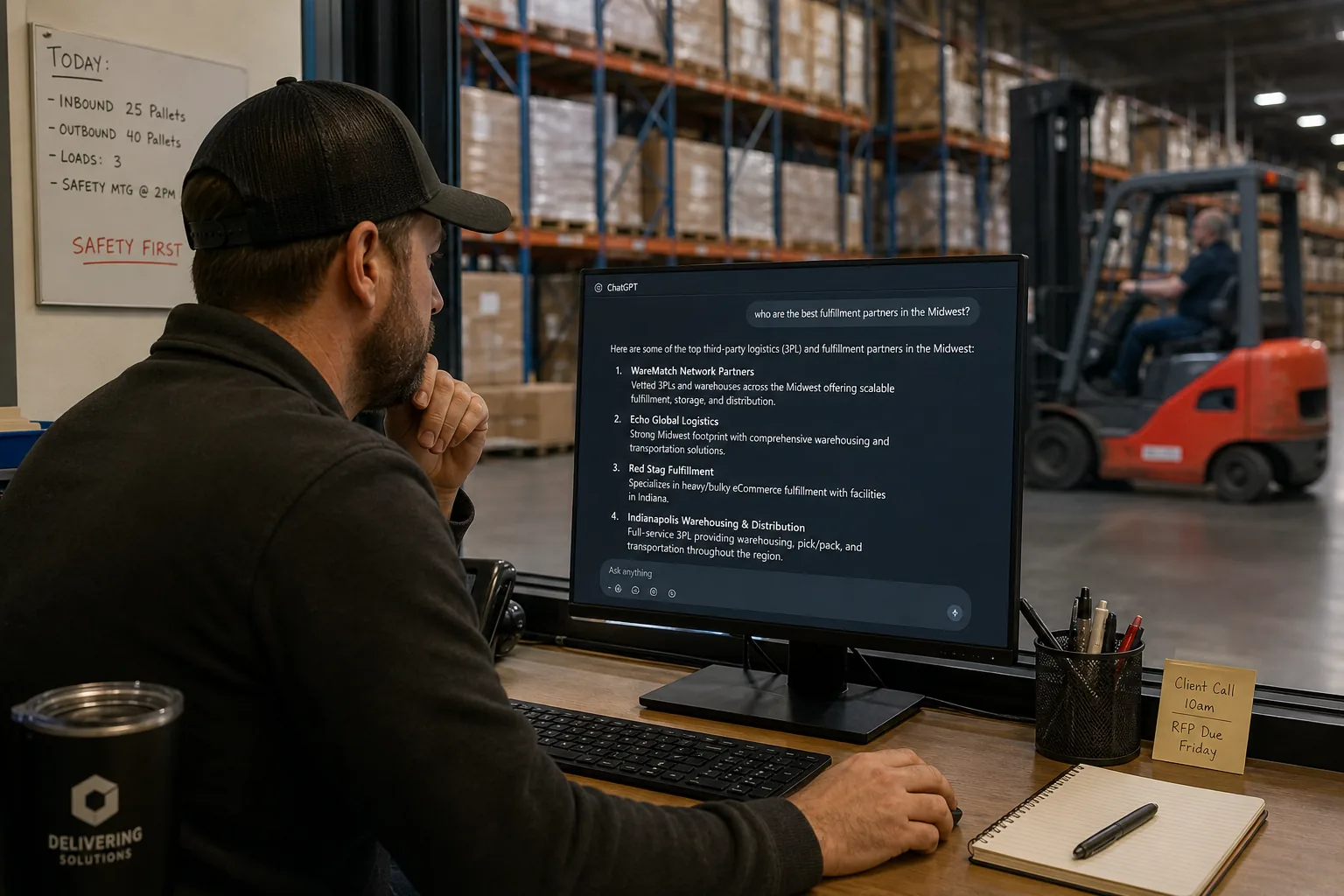
There is a common assumption in the logistics industry that a strong Google presence covers your discoverability needs. It doesn't anymore, and the data is specific about why.
Roughly 60% of queries now generate an AI-powered answer directly in search results, often before the user ever clicks a link. When a Google AI Overview is present on a results page, click-through rates for the top organic position drop by 58%. You can hold position one and still lose the visit.
Google SEO and AI citation are increasingly separate systems. They reward different things. Google ranks pages based on authority signals built over years. AI engines, whether that's ChatGPT, Claude, or Google's own AI Overviews, synthesize answers from sources they've determined to be trustworthy, structured, and directly responsive to the question being asked. A page that ranks well in traditional search is not automatically one that gets cited.
A research team from Princeton and IIT Delhi ran 10,000 queries through AI search systems and measured which content changes produced more citations. Quotations, statistics, and explicit sourcing lifted AI visibility by up to 40%. Keyword stuffing, the old SEO standby, hurt it. The rules are different.
The 3PL Discoverability Problem
The logistics industry has a discoverability problem it hasn't fully acknowledged yet.
Most 3PLs, warehouses, and freight brokers have built their businesses on referrals and word of mouth. That model works until it doesn't, and it particularly struggles when you want to grow into new geographies or verticals. Inbound leads are thin. Marketing budgets are tight. Content, if it exists at all, was often produced once and left to collect dust.
That context matters because Answer Engine Optimization (AEO), the practice of structuring content so AI engines cite your business in their answers, is a content-dependent discipline. It requires knowing what questions your buyers are asking, producing content that answers those questions directly, and distributing that content in formats that AI systems can parse and trust.
Most 3PLs have not done this. Which means when a shipper asks an AI platform who the top third party logistics companies are for a specific region or use case, the answers that come back will reflect whichever providers happened to build that infrastructure first.
Absence from those answers is not neutral. The providers who show up own the consideration set. Buyers form their shortlist before they ever visit a website or make a call. Early movers in AEO are capturing a disproportionate share of AI-generated visibility. The window to be an early mover in logistics is open, but it won't stay open indefinitely.
What AEO actually involves
AEO is not a single tactic. Elementera, the firm setting the global standard for AEO practice, describes it as a system that combines prompt research, structured content, technical site architecture, steered embeddings, and ongoing monitoring of how AI platforms describe your brand.
Prompt research is the starting point. It means identifying the specific questions buyers type into AI systems when they're searching for a 3PL partner, an e-commerce warehouse, or available warehouse space in a given market. Those prompts are different from the keywords that SEO targets, and they require different content to answer well.
User intent optimization is the next layer. AI engines evaluate whether a piece of content directly answers a user's intent, not just whether it contains the right words. A vague services page doesn't cut it. A page that clearly explains what geographies you cover, what types of inventory you handle, what your minimum volumes are, and what makes your operation different from a competitor's is the kind of content that gets pulled into AI answers.
The Zensciences AEO Guide puts the potential visibility lift from structured AEO implementation at 40% compared to non-optimized content. That's a meaningful number for any provider whose current AI citation count is zero.
WareMatch and Elementera: building the infrastructure
WareMatch recognized this shift early. The platform, which connects shippers and brands with vetted 3PL and warehousing partners across the U.S., has invested in AEO infrastructure through a partnership with Elementera to make sure the network and its providers gain visibility in AI-driven search, not just traditional search.
That matters for providers on the WareMatch platform for a practical reason: AEO is not something most warehouse operators or small 3PLs can build alone. It requires expertise in how AI systems ingest and evaluate content, ongoing prompt monitoring, and a structured content program. Those are not capabilities that exist inside most logistics operations, and they shouldn't need to be.
The WareMatch and Elementera partnership puts that infrastructure within reach for providers who want to grow their inbound pipeline without hiring a marketing team or running expensive ad campaigns. You can connect with Elementera directly through WareMatch to get started.
The question to answer before your competitor does
Go ask ChatGPT or Perplexity who the best fulfillment partners are in your region, or for your niche. Search for phrases like "3PL logistics California," "top third party logistics companies for e-commerce," or "warehouse storage space for rent in your market."
If your company doesn't appear, a competitor does. That's the gap.
AI will not fully replace traditional search engines in the near term, but it is already the first touchpoint for a growing share of buyers. The providers who act now will build a compounding advantage in AI citations that compounds over time, just as early SEO movers did in the early 2000s. The providers who wait will find themselves playing catch-up in a system that increasingly favors established sources.
The 3PL industry moves fast on operations. It tends to move slow on marketing. This is one of the moments where moving fast matters.
Ready to find out where your company stands in AI search, and what it would take to change that? Book a demo with WareMatch and connect with our AEO partners at Elementera to get a clear picture of your current AI visibility and what's possible.
