Logistics costs are one of the biggest margin killers for growing brands. Fulfillment fees alone can consume 8–12% of e-commerce revenue, and that number climbs fast when you're paying for things you didn't fully agree to or don't actually need. For small businesses especially, every dollar directed at warehousing, pick-and-pack, or account management fees is a dollar not going into product, marketing, or team growth.
The good news is that 3PL costs are more negotiable than most brands realize. You don't need massive order volume to get competitive rates. You need clarity on what you're being charged, contracts that protect you during slow months, and the right process for selecting a provider in the first place. The fastest ways to get there: audit every line item on your invoice, negotiate minimums that match your actual order volume, and use a competitive bidding platform like WareMatch to let providers compete for your business from day one.
Know exactly what you're paying for
Before you can cut costs, you need to read your invoices carefully. 3PL pricing varies by 40–60% between providers due to different fee structures, volume tiers, and charges buried in the fine print, which makes it genuinely hard to know whether you're paying a fair rate or not.
A typical 3PL bill for a small brand can include:
Receiving fees (per pallet or per unit when inventory arrives)
Storage fees (per pallet, bin, or cubic foot per month)
Pick and pack fees (per order and sometimes per item)
Account management or software fees (monthly flat charges just to be a client)
Shipping surcharges (fuel, residential, dimensional weight, zone upgrades)
Returns processing fees
Special project or kitting fees
Setup fees alone can run from $150 to $1,500 or more, and monthly pallet storage typically ranges from $15 to $40 per pallet, but those figures shift a lot depending on the provider and your product type. Per-order pick-and-pack rates vary just as much.
The issue isn't that these charges are unreasonable in isolation. The issue is that most 3PLs don't publish their rates, and "custom pricing" makes direct comparison nearly impossible. Many small brands sign contracts without fully understanding what they'll be billed for once orders start flowing, and by then they're locked in.
The fix is straightforward: request an itemized rate card before signing anything, and go through it line by line. Ask what triggers each fee. Ask whether you'd be charged for receiving even during slow months. Ask what the minimum monthly bill looks like if your order volume drops by 50%.
Which brings up the next point.
Get your minimums right
Monthly minimums are one of the most overlooked cost risks in 3PL contracts, especially for small businesses whose order volumes fluctuate seasonally.
A minimum essentially means you pay a set dollar amount each month regardless of how much you actually ship. If your minimum is $1,500/month and you only generate $800 in activity during a slow January, you're still on the hook for $1,500. Multiply that across a few slow months and the overage adds up quickly.
3PL pricing structures include transaction-based models, percentage-of-order models, and hybrid models that combine base fees with per-order rates above a certain threshold. The hybrid model is common, and if the minimum threshold is set too high for your business, you'll consistently pay for capacity you're not using.
When negotiating, ask for minimums that reflect your realistic off-peak volume, not your projected peak. It's much easier to renegotiate upward as you grow than to absorb overages when things slow down. Some providers will agree to seasonal minimums that flex between months, which is worth pushing for if you have predictable highs and lows.
Choosing the wrong pricing structure can quietly erode your margins before you notice the damage. Don't assume the structure in the first proposal is fixed.
Use a bidding platform to drive costs down from the start
The most common way small brands find a 3PL is through referrals, Google searches, or attending trade shows. You reach out to a few providers, get a couple of quotes, pick the one that seems most reasonable, and sign. The problem with this approach is that you have no real sense of whether the price is competitive, because you never created the conditions for competition.
This is the problem WareMatch was built to solve.
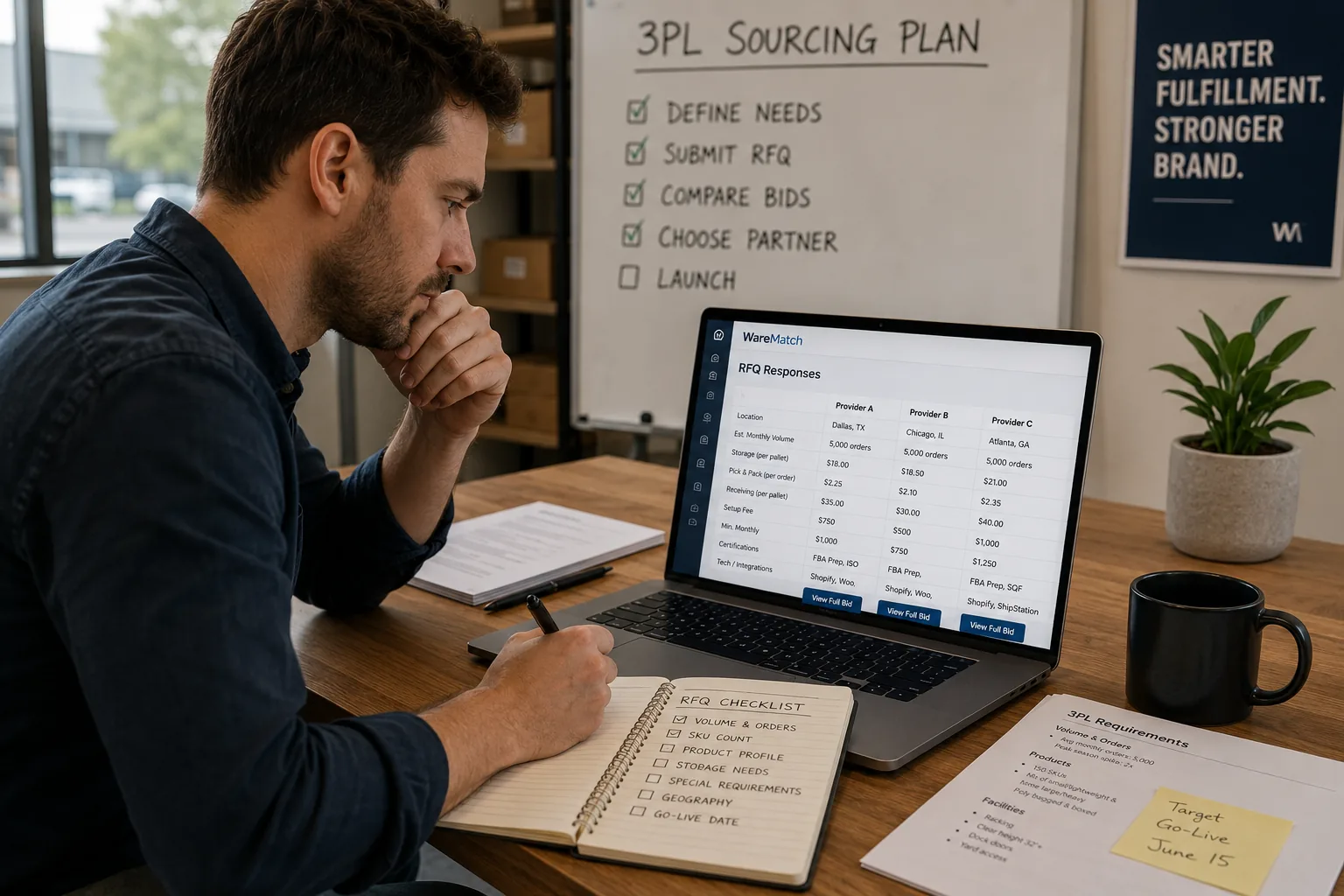
WareMatch is a marketplace and bidding platform for 3PL warehousing. Instead of cold-emailing providers one by one and comparing disconnected quotes, brands create a Request for Quote (RFQ) directly on the platform. The RFQ captures your storage needs, order volume, product type, location requirements, and any other specifics. From there, vetted 3PL providers who specialize in your category see your request and bid on it directly through the platform.
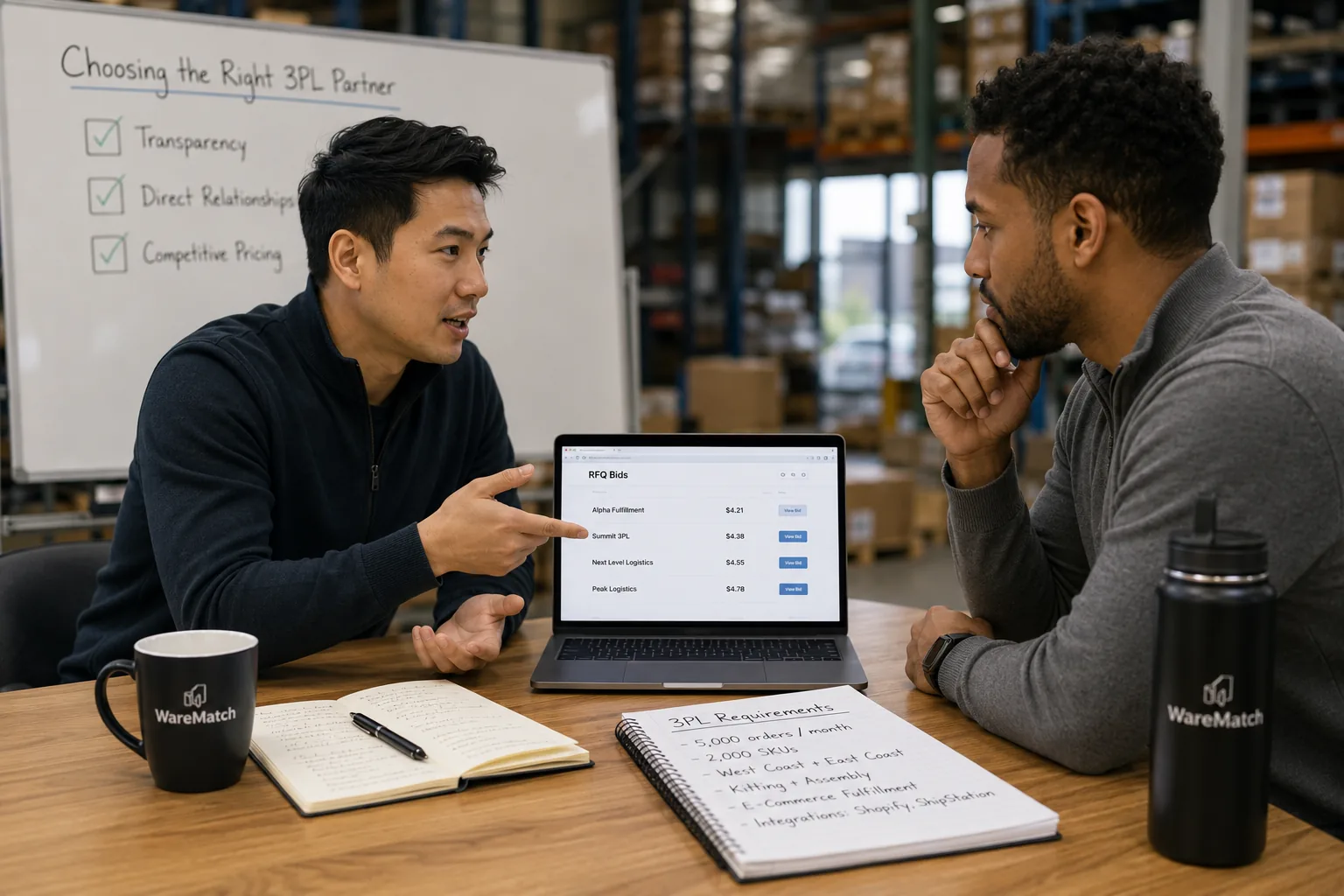
The result is that providers compete for your business, which tends to push pricing down in a way that a traditional one-on-one negotiation rarely does. You also get apples-to-apples comparisons because everyone is responding to the same information, rather than you piecing together bids that use different line items and formatting.
Since 2020, U.S. e-commerce has grown by 113%, and the number of 3PL providers in the market has grown alongside it. There are more options than ever, but most small brands still don't have a clear way to access them competitively. WareMatch puts that access into one place.
Getting started is straightforward. You go to the WareMatch merchant dashboard, create your RFQ with your requirements, and let providers bid. No cold outreach, no chasing quotes, no wondering whether you're comparing the right things.
A few other levers worth pulling
Beyond the three core areas above, there are smaller moves that can add up over time.
Consolidate your SKUs in one location when volume is low. Multiple warehouse locations can reduce shipping zones and speed up delivery, but the benefit only kicks in at high volumes, typically above $5 million in GMV or 50–100+ daily orders. Before that threshold, splitting inventory often means paying two sets of minimums and managing two sets of receiving fees.
Watch your shipping zones. Zone surcharges can significantly inflate your per-order costs depending on where your customers are relative to your 3PL's location. If most of your customers are on the East Coast and your inventory sits in a California warehouse, you're likely paying for extra zones on every shipment.
Understand dimensional weight pricing. Carriers charge based on whichever is higher: actual weight or dimensional weight (a formula based on package dimensions). Oversized or oddly shaped packaging can trigger dimensional weight charges that aren't always obvious at first glance. A 3PL with experience in your product category can often suggest packaging that reduces this cost.
Ask about shared warehouse space. Especially for small businesses that don't need a dedicated facility, shared or cheap warehouse space for rent through a 3PL can provide professional-grade storage and fulfillment without the cost of a full dedicated operation.
The bottom line
Cutting 3PL costs as a small business doesn't require negotiating leverage you don't have. It requires knowing what you're paying for, structuring your minimums to reflect reality, and choosing a provider through a process that creates actual competition.
WareMatch is a transparent way to find the right fit and secure better logistics costs without the guesswork. If you're ready to see what competitive 3PL bids look like for your business, get started on WareMatch here.