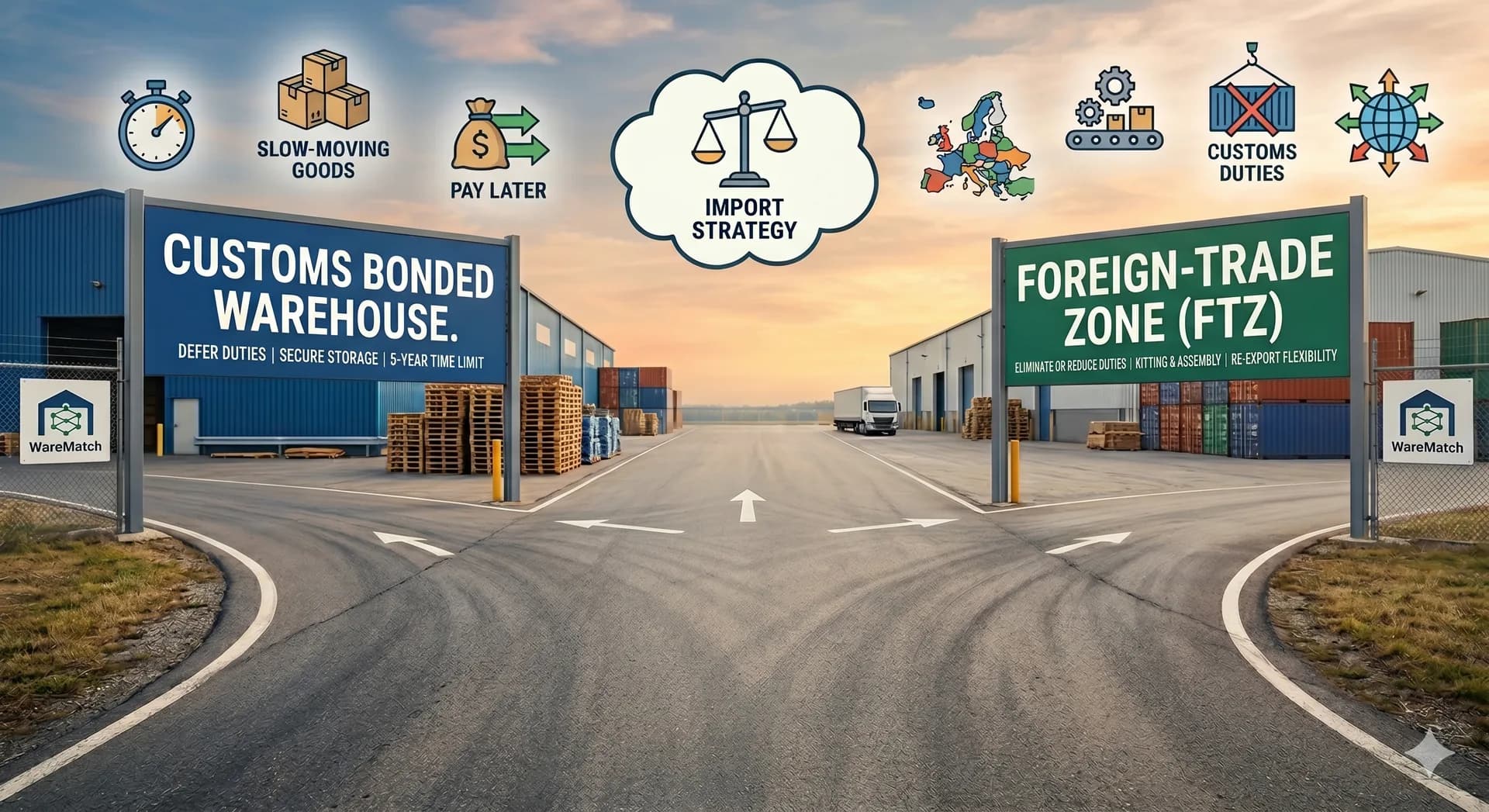
Picture this: You import $200,000 worth of inventory. You pay the import duties upfront. Half of that inventory sits on a shelf for four months. Some of it gets returned. Some of it eventually gets exported to Canada or Europe. Throughout this entire cycle, you’ve tied up crucial cash in duties unnecessarily.
Between tariff volatility and rising logistics costs, managing cash flow is critical. Yet, paying import duties the moment goods hit U.S. soil is one of the biggest, most avoidable cash drains for growing businesses.
If you want to stop overpaying duties and start protecting your working capital, two tools can help: bonded warehouses and Foreign-Trade Zones (FTZs).
Here is a practical, decision-making guide to what these options are, the real-world trade-offs, and how to know which one makes sense for your business.
What Is a Bonded Warehouse?
A bonded warehouse is a highly secure storage facility supervised by U.S. Customs and Border Protection (CBP). When you store imported dutiable merchandise in one of these facilities, you do not pay customs duties until the goods are officially withdrawn for domestic consumption.
The biggest misconception: Bonded warehouses do not make duties disappear. They simply delay the payment. You still owe the duty, but you gain control over when you pay it.
The real-world nuance: Bonded storage isn't indefinite. By law, goods can generally only stay in a bonded warehouse for up to five years. Additionally, there is a strict administrative burden to maintain compliance, which means storage costs in these facilities are often slightly higher than standard warehousing.
What Is a Foreign-Trade Zone (FTZ)?
An FTZ takes duty management further. While physically located in the U.S., an FTZ is legally considered outside of U.S. customs territory for duty purposes.
Because of this unique status, you can do a lot more with your product. Inside an FTZ, you can assemble, kit, relabel, manipulate, and even manufacture goods. If those goods are eventually exported to another country without ever officially entering the U.S. market, U.S. duties are eliminated entirely.
The biggest misconception: People assume FTZs are only for massive automotive or electronics manufacturers. In reality, SMBs and ecommerce brands frequently use FTZs for kitting, bundling, or relabeling imported components.
The real-world nuance: Setting up and activating FTZ space comes with high initial setup costs and stringent ongoing reporting requirements to CBP. It requires a dedicated, tech-enabled logistics partner to manage it properly.
The Decision Framework: Which Do You Need?
Choosing between the two shouldn't be a guessing game. It comes down to a clear set of operational constraints and financial goals:
If you need simple storage + cash flow relief → Bonded Warehouse. Best for deferring payments on slow-moving or seasonal goods until they actually enter the market.
If you need operational flexibility + tariff optimization → FTZ. Best if you are manipulating the product (kitting, manufacturing) or if a large portion of your inventory is destined for re-export.
If your import volume is low → Neither may be worth it. The compliance and administrative fees might outweigh the duty savings.
What is "Inverted Tariff Relief"?
One of the most powerful financial advantages of an FTZ is "inverted tariff relief." Sometimes, the raw materials you import have a higher duty rate than the finished product you eventually sell.
For example, if imported electronic parts are taxed at 10%, but the finished device is only taxed at 5%, assembling those parts inside an FTZ allows you to pay the 5% rate when the finished device finally enters the U.S. market. It is a completely legal way to reduce your tax burden through smart supply chain design.
When NOT to Use These Options
Logistics strategies aren't one-size-fits-all. A bonded warehouse or FTZ is a bad idea if:
You have fast inventory turnover: If your goods fly off the shelves within days or weeks of landing, the cash flow benefit of delaying a duty payment isn't worth the extra administrative cost.
Your import volume is low: The strict customs reporting, bonds, and specialized 3PL fees will eat up whatever small amount you save on duty deferral.
You have simple, domestic-only operations: If you aren't re-exporting or manufacturing, the heavy-duty benefits of an FTZ are overkill.
Finding the Right 3PL for the Job
If the strategy makes sense, execution is everything. You cannot run this playbook without a highly capable partner. When searching a 3PL marketplace for providers, you need to ask granular questions to ensure they can actually handle the complexity:
Do you offer full FTZ activation support, or just standard bonded space? What specific customs reporting systems do you use to stay compliant with CBP?
How does your Warehouse Management System (WMS) handle duty deferral tracking? Will I have real-time visibility into my duty liabilities?
The Bottom Line
Stop tying up cash in duties you don’t need to pay yet. Most importers don’t realize how much working capital they are losing by accepting upfront customs bills as a cost of doing business.
At WareMatch, our mission is to remove the friction from finding specialized logistics partners. We've built a platform that cuts through the noise, matching you with vetted 3PL providers that have the exact infrastructure you need.
Ready to optimize your cash flow and operations? Explore fulfillment partners on WareMatch that offer specialized storage by viewing our bonded warehousing options today.
Frequently Asked Questions (FAQ)
What is the difference between a bonded warehouse and an FTZ?
The core difference is flexibility. A bonded warehouse allows you to defer paying duties while goods are stored securely. An FTZ is legally outside U.S. customs territory, allowing you to defer duties, manipulate or manufacture the goods, and potentially eliminate duties entirely if the goods are re-exported.
Can ecommerce brands use FTZs?
Yes. While historically used by large manufacturers, ecommerce brands leverage FTZs to defer duties on bulk imports, kit and bundle components before they enter the U.S. market, and eliminate duties on orders that are shipped internationally.
Do you pay duties in a bonded warehouse?
You do not pay duties while the goods are sitting inside the bonded warehouse. The duties are only paid when the goods are officially withdrawn from the facility and enter the U.S. market for consumption.