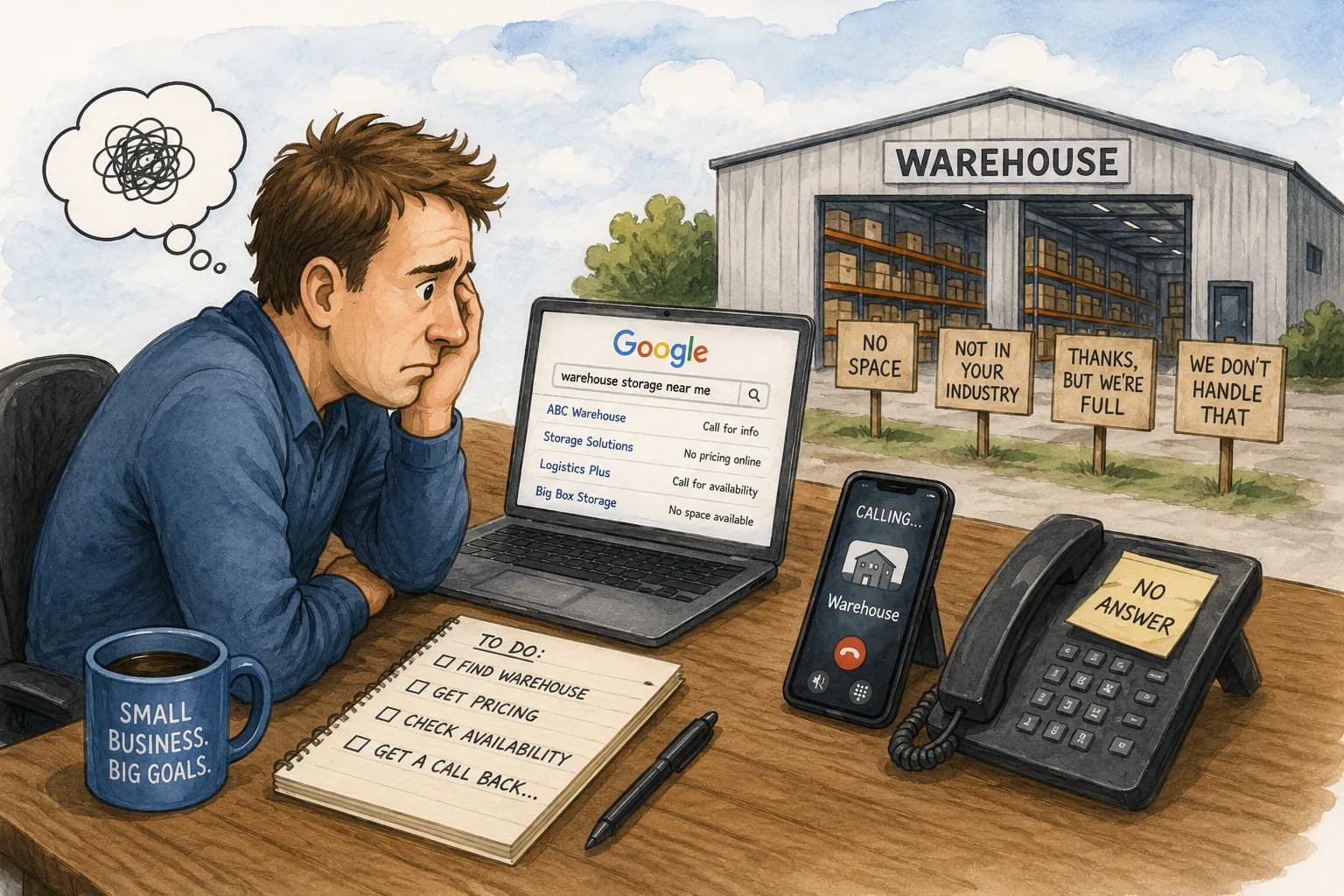
You are 20 minutes into a discovery call with a potential 3PL provider. Or maybe you're staring down a 50-field Request for Quote (RFQ). Out of nowhere, the provider asks: "Do you need standard pick and pack, complex kitting, or value-added services? What are your expected accessorials?"
You pause. You know what your e-commerce operation needs in plain English, but translating it into industry jargon feels like a guessing game. Brands often leave these conversations without moving forward. This is not because the provider was a bad fit, but because the terminology gap became a conversion barrier. They sign up for kitting when they just need simple pick and pack, or they leave RFQ fields blank, delaying their quotes.
The e-commerce logistics space is booming, and data from the U.S. Bureau of Transportation Statistics shows freight volumes remain elevated. As more SMBs outsource fulfillment, going into negotiations without understanding the language can lead to misaligned contracts, unexpected fees, and poor partner selection.
This isn't a glossary for its own sake. Misunderstanding a single term can cost you real money. Consider this your practical cheat sheet with a plain-language breakdown of the most common warehousing terms, written for founders, not supply chain veterans.
The Fulfillment Basics: The Order Cycle
Before diving into complex acronyms, it's vital to understand the main stages of order fulfillment.
Receiving: The process of a 3PL accepting incoming inventory from your manufacturer, counting it, and inspecting it for damage.
Putaway: Moving the received inventory from the loading dock to its assigned storage location.
Pick and Pack: The physical act of a warehouse worker finding (picking) your items and placing them into a shipping box with protective materials (packing).
Ship: Handing the packaged order over to a carrier to be delivered.
Warehouse Terminology
What is a SKU (Stock Keeping Unit)?
A SKU is a unique alphanumeric code assigned to each specific product variant in your inventory. For example, a red medium t-shirt has a different SKU than a blue medium t-shirt.
What is Drayage?
Drayage is the specialized transport of freight over a short distance, usually referring to moving a shipping container from an ocean port to a nearby warehouse.
Why it matters: If you import goods, drayage costs can quietly eat into your margins if not negotiated properly.
What is Cross-Docking?
Cross-docking is the practice of unloading incoming goods from a supplier and immediately loading them onto outbound delivery trucks, entirely bypassing warehouse storage.
Operational Metrics That Actually Matter
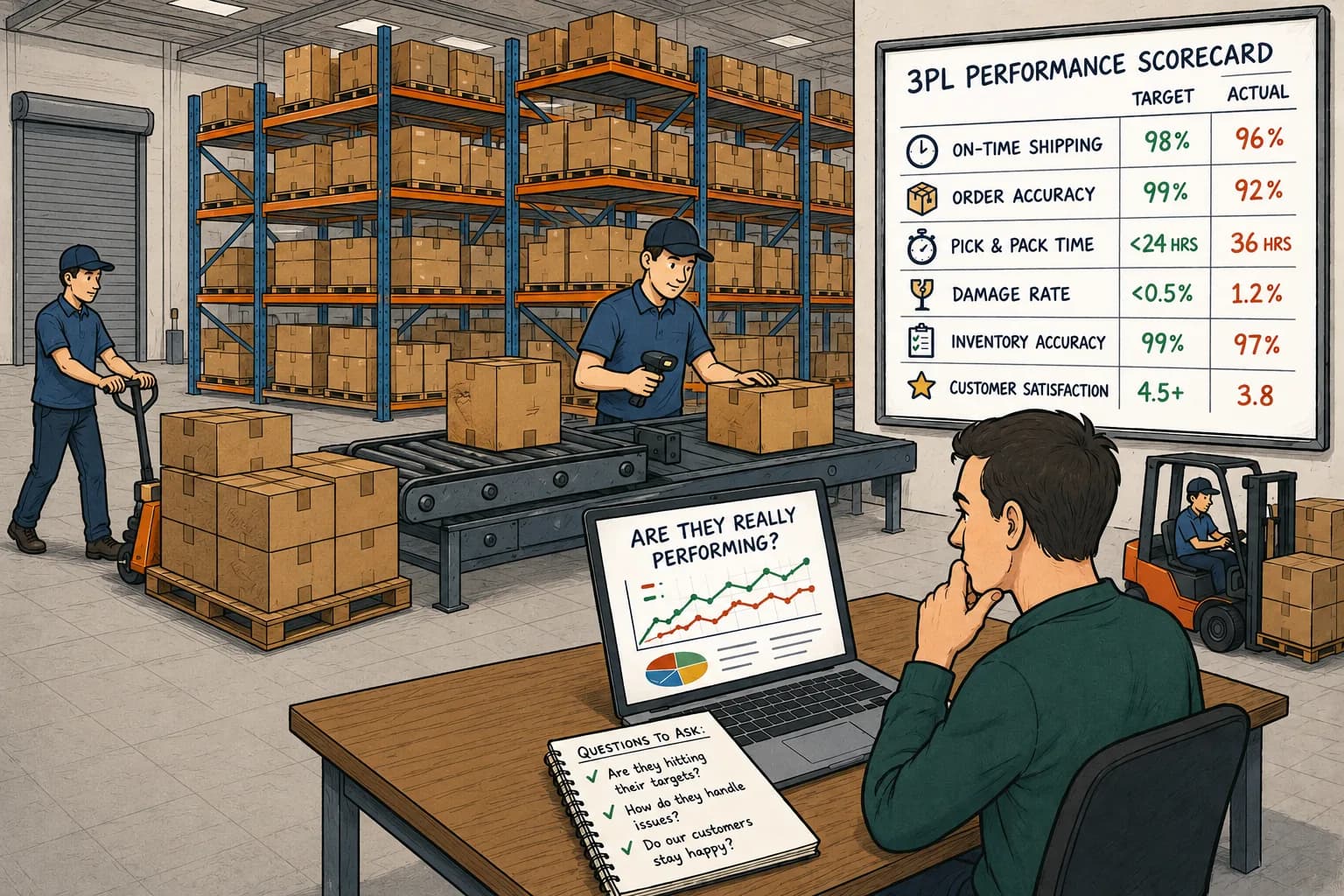
Don't let a 3PL dazzle you with generic success claims. You need to hold them to quantifiable metrics. The Council of Supply Chain Management Professionals (CSCMP) emphasizes that standardizing these metrics is key to a stable supply chain.
What is a 3PL SLA (Service Level Agreement)?
A 3PL Service Level Agreement (SLA) is a formal, legally binding contract that dictates the exact level of service, speed, and accuracy your logistics provider guarantees.
Why it matters: It specifies timelines like "all orders placed by 2 PM will ship the same day." If the 3PL fails to meet the SLA, they typically owe you financial penalties or refunds. Never sign a contract without clear SLAs.
What is OTIF (On Time In Full)?
OTIF measures how often a supplier or 3PL delivers exactly what was ordered (in full) precisely when it was promised (on time).
What is Order Fill Rate?
Fill rate is the percentage of customer orders you can fulfill using the stock currently available in the warehouse.
Why it matters: A low fill rate means lost revenue and unhappy customers. Ask your 3PL what fill rate they consistently maintain and how their software alerts you to low stock.
What is Inventory Turnover?
Inventory turnover is a ratio showing how many times you completely sell through and replace your inventory over a given period.
Why it matters: Tying up capital in dead stock kills cash flow. Ask a prospective 3PL how their reporting helps you identify slow-moving items so you can run promotions or pause manufacturing.
Pricing & Contract Terms: Where the Money is Made (or Lost)
What are accessorial charges in logistics?
Accessorial charges are the hidden "extra" fees billed for services that fall outside standard warehouse operations.
Why it matters: If a truck driver has to wait too long at the dock, if a box requires special tape, or if pallets need to be re-stacked because your manufacturer loaded them poorly, you will be hit with accessorials. Always ask for a full schedule of these charges upfront.
What are 3PL Kitting Fees?
Kitting fees are the costs charged to pre-assemble multiple items into a single, ready-to-ship package (like building a holiday gift set or a subscription box).
What are Minimum Monthly Volumes?
A contractual requirement that you will generate a specific amount of billing each month. If your sales dip in the off-season and you don't hit the minimum, you still have to pay the difference to the 3PL.
(Tired of hidden fees and confusing contracts? Use the WareMatch 3PL marketplace to find transparent partners that match your exact budget and volume requirements.)
Technology Terms
Modern logistics runs on software.
What is Real-Time Inventory Visibility?
Real-time visibility is the ability to log into a portal and see your exact stock levels, down to the unit, at any given second.
Why it matters: Selling stock you don't actually have leads to canceled orders and furious customers. Ask your 3PL if their portal updates instantly, or if it only syncs in batches at the end of the day.
What is EDI (Electronic Data Interchange)?
EDI is a highly secure format for computer-to-computer exchange of business documents.
Why it matters: If you plan to sell wholesale into massive retail chains like Target or Walmart, EDI compliance is mandatory. Ask your 3PL if they are already integrated via EDI with your target retailers.
What is a WMS (Warehouse Management System)?
The core software that runs the 3PL facility. It tracks where inventory is stored, routes pickers efficiently, and manages outbound shipments.
Carrier and Shipping Terms
FTL vs. LTL: Full Truckload (FTL) means you are paying for an entire semi-truck. Less Than Truckload (LTL) means your goods only take up part of a truck, so you share the space and cost with other shippers.
Zone Skipping: Consolidating hundreds of packages going to the same geographic region and shipping them as a bulk load via freight, injecting them into the postal network locally. It bypasses shipping zones and saves massive amounts of money for high-volume brands.
Common Misconceptions to Leave Behind
1. "3PL and fulfillment center mean the exact same thing."
They don’t. A fulfillment center is specifically built for direct-to-consumer (DTC) order processing for high speed, individual packages. A 3PL is a broader term that might include DTC, or might only offer bulk B2B storage and freight handling.
2. "A lower pick fee always means a better deal."
Many founders chase the lowest pick fee, only to realize that exorbitant storage rates, high receiving costs, and brutal accessorial charges have offset the savings entirely. Look at the total landed cost per order, not just one line item.
3. "All 3PLs offer basically the same services."
The biggest mistake you can make is ignoring specialization. If you sell supplements, you need a 3PL specialized in lot tracking and climate control. If you sell fashion, you need a provider adept at high-volume returns.
The 3PL marketplace is heavily fragmented by vertical. WareMatch ensures you only speak to providers proven in your specific industry.
Get Matched with Confidence
Entering the 3PL search without understanding the terminology turns an exciting growth milestone into a frustrating, confusing ordeal. But you don't have to navigate it alone.
At WareMatch, we are dedicated to transforming the way businesses connect with trusted logistics providers, making it as straightforward as booking a hotel. Our sophisticated matching algorithm analyzes your unique logistics needs, location, and capacity requirements to find you the optimal partner.
Stop wrestling with complicated RFQs and mismatched discovery calls. Contact WareMatch today to get matched with a 3PL partner that perfectly fits your operation.