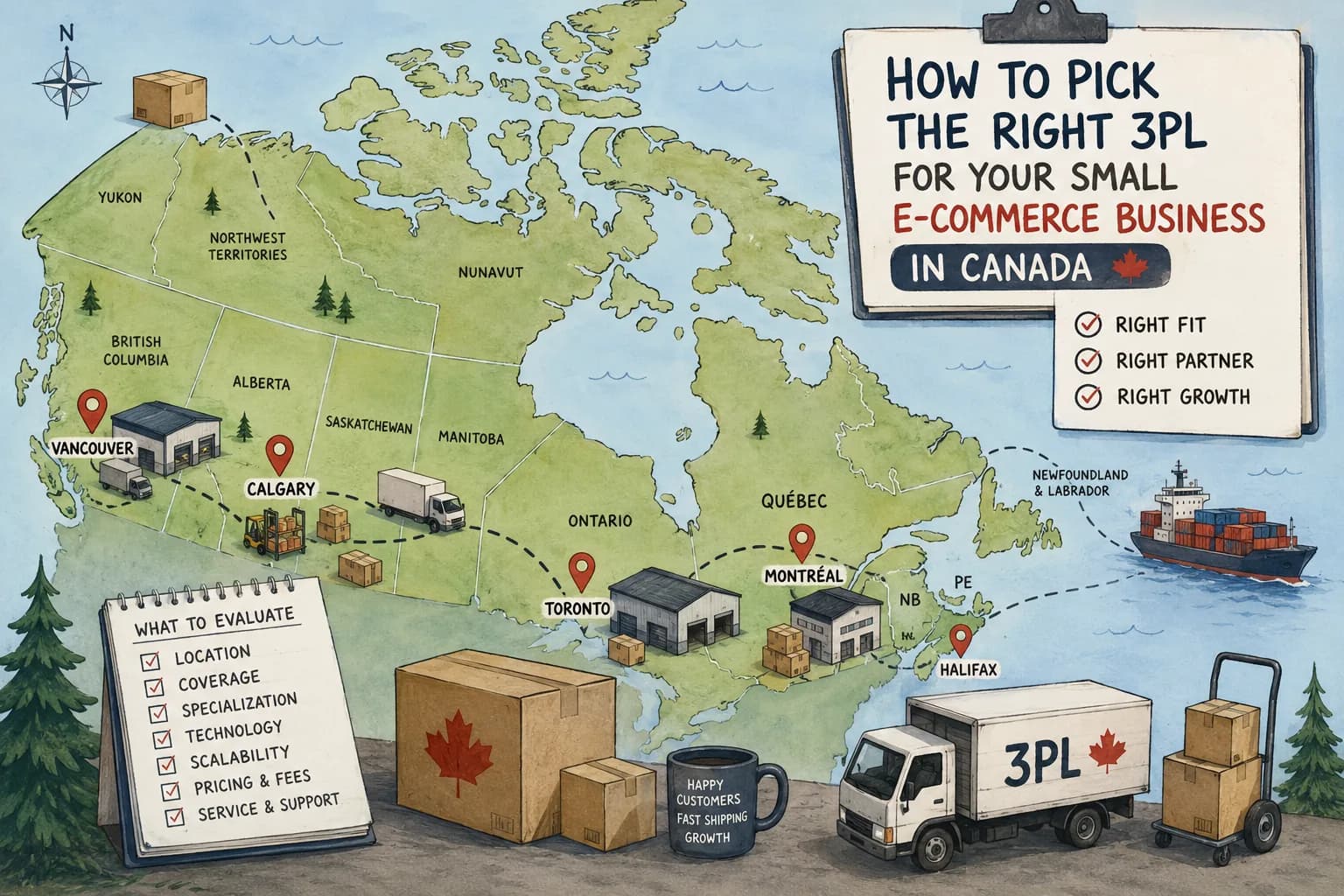
If you're setting up a distribution centre in Canada and you've narrowed it down to Toronto or Vancouver, you're already asking the right question. But the answer isn't a city name. It's a set of trade-offs that depend entirely on where your customers are, where your goods come from, and how much volume you're moving.
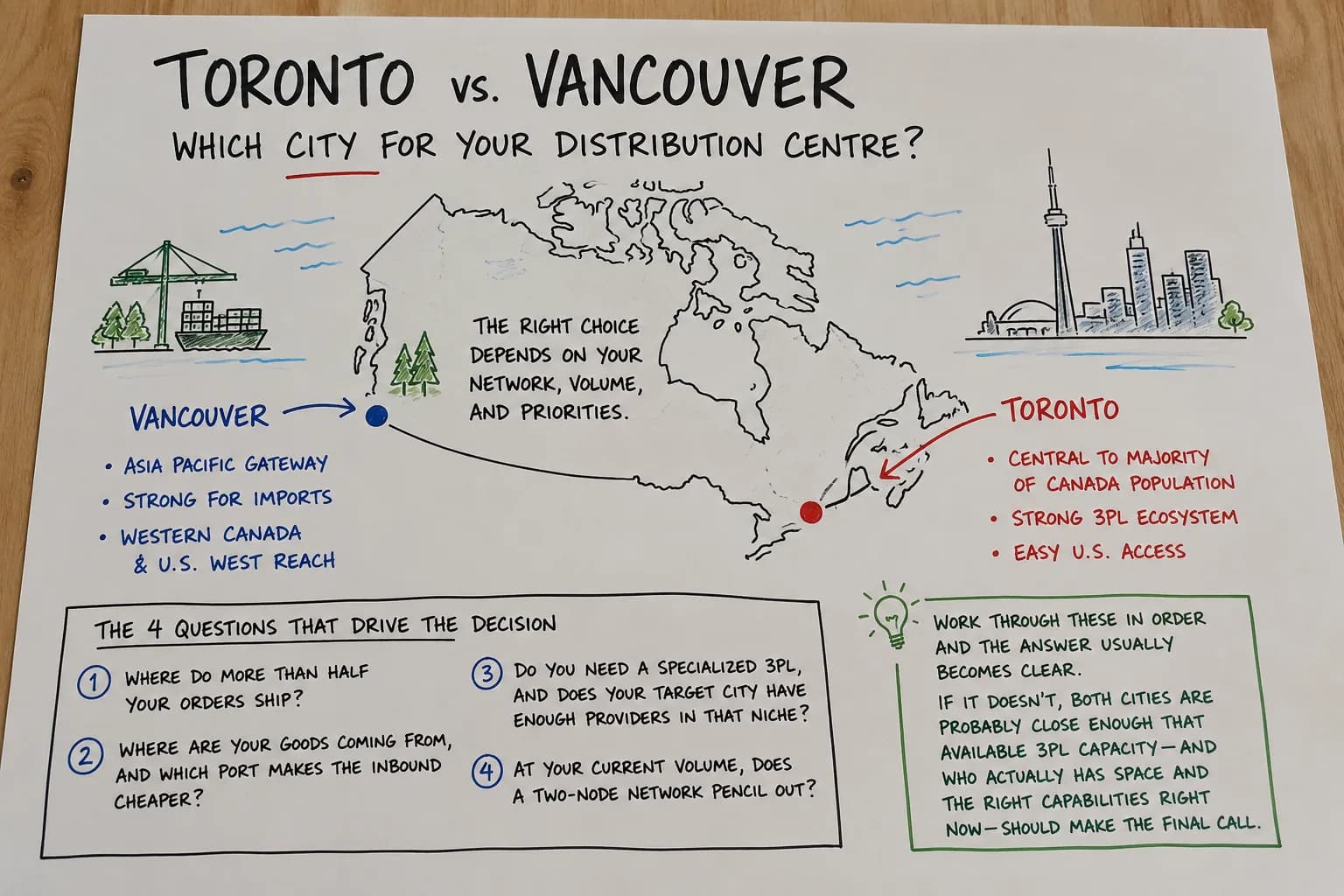
The decision comes down to four questions: Where do more than half your orders ship? Where are your goods coming from, and which port makes the inbound cheaper? Do you need a specialized 3PL, and does your target city have enough providers in that niche? And at your current volume, does a two-node network pencil out?
Work through those in order and the answer usually becomes clear. If it doesn't, both cities are probably close enough that available 3PL capacity, and who actually has space and the right capabilities right now, should make the final call.
Here's how each of those questions plays out in practice.
Where are your customers?
This is the first question, and it usually settles the debate faster than any other variable.
Canada's population is concentrated east of Manitoba. Ontario alone accounts for roughly 38% of the national population, and when you include Quebec, you're covering more than half the country. If the majority of your orders ship to addresses in Ontario, Quebec, or the Atlantic provinces, a Toronto-area (GTA) distribution centre will cut your outbound transit times and last-mile costs considerably compared to shipping from the west coast.
The reverse is also true. If your customer base is concentrated in British Columbia, Alberta, and the Pacific Northwest markets you're serving cross-border, Vancouver makes more sense. The issue is that most Canadian e-commerce and B2B volumes skew east. That doesn't make Vancouver wrong, but it means you need to validate the assumption with your own order data before committing.
A practical starting point: pull your last 90 days of orders and map them by postal code. If the bulk of your volume is landing in the 416, 905, 613, 514, and surrounding regions, that's your answer.
How are your goods coming in?
Inbound logistics costs are the other side of the equation, and this is where Vancouver can offer a genuine structural advantage for certain import profiles.
If your product comes from Asia, including China, Japan, South Korea, Taiwan, or Southeast Asia, Vancouver is likely the cheaper port of entry. The Port of Vancouver is Canada's largest port by volume, and containers from transpacific trade lanes arrive there faster and with shorter ocean transit times than they would routing through a U.S. west coast port and trucking north, or taking an all-water route to the east coast.
Drayage costs from the Port of Vancouver to a Metro Vancouver warehouse are also generally lower than inter-modal moves that get a container from Vancouver all the way to the GTA. That inland haul adds cost and transit time that erodes the inbound advantage if your customers are in Ontario anyway.
If your goods arrive from Europe, the U.S. East Coast, or via the St. Lawrence Seaway, Toronto's geography works in your favour on the inbound side. The Port of Montreal, which feeds into the GTA rail and trucking network, is well suited to Atlantic trade lanes. Toronto also has direct access to the U.S. trucking corridor, which matters if you're cross-docking or sourcing domestically from American suppliers.
As we've written about before on the WareMatch blog, port of entry is fundamentally a warehousing decision, not just a shipping one. Where your freight lands sets up the cost structure for everything downstream.
Supply of 3PLs: Toronto has more of them
If you're not building your own facility and are instead looking for a third-party logistics provider (3PL) to handle your warehousing and fulfillment, the GTA has a clear advantage in terms of provider density and specialization.
The Greater Toronto Area is Canada's largest industrial and logistics real estate market, with a disproportionately large share of the country's total industrial inventory. Toronto contributed 40.9% of all new national industrial supply in Q1 2026, according to Cushman & Wakefield's Industrial Marketbeat. More space means more operators, more competition among providers, and a better chance of finding a 3PL that specializes in your product category, whether that's temperature-controlled, hazmat, apparel, or high-value electronics.
Vancouver's 3PL market is active, but it's smaller. Metro Vancouver's industrial vacancy rate sits around 4.1% as of the most recent Avison Young Metro Vancouver industrial market report, which is tighter than many markets. Some reports from Altus Group put the availability rate higher, at 6.6% year-over-year, attributed partly to cooling port-related logistics demand. Either way, the physical inventory of available warehouse space and the number of 3PLs operating within it is smaller than what you'll find in the GTA.
That matters most when you have specific requirements. If you need a 3PL with experience in cold chain, or one with EDI integration for retail compliance, or a provider set up to handle oversized freight, you're more likely to find multiple options competing for your business in Toronto than in Vancouver.
What does the industrial market actually look like right now?
A few data points worth knowing as of Q1 2026.
National industrial vacancy fell to 3.5%, the first national decline since 2022. Toronto, Vancouver, and Calgary drove 76% of all new construction starts across the country, according to Colliers data cited in the Globe and Mail in April 2026.
On rents, the national average net asking rent closed 2025 at $15.11 per square foot, down 4.5% year-over-year, though the rate of decline has slowed to around 0.6% per quarter per Cushman & Wakefield. City-specific rates vary significantly. Vancouver historically carries some of the highest asking rents in the country due to constrained land supply. Toronto's sheer volume of new supply coming online has put some downward pressure on rates, which can work in your favour if you're negotiating now.
None of these figures are a reason to pick one city over the other on their own. They're context for understanding that both markets are active and that your negotiating position differs depending on where you land.
The misconception that cheaper warehouse rates mean a cheaper project
This is worth spending a moment on, because it comes up constantly.
Say you find a 3PL in Vancouver quoting $12 per square foot and a GTA provider quoting $14. The instinct is to assume Vancouver saves you money. But if 70% of your orders ship to Ontario and Quebec, you're now paying more per shipment, on a higher volume of shipments, every month. That freight difference compounds. Over a year, it can easily exceed the rent savings by a factor of three or four, depending on your volume and average order weight.
The right way to model this is total landed cost per order to your customer, not rent in isolation. That means factoring in inbound freight to the DC, outbound freight from the DC to end customers by region, and the cost of any inventory you're holding because longer transit times require higher safety stock levels.
A cheaper warehouse rate in the wrong city is a cost, not a saving.
Could two nodes make sense?
If your volume is high enough, the Toronto-versus-Vancouver framing may be the wrong question entirely.
A two-node network, with a facility or 3PL in each city, allows you to serve western Canada from Vancouver and eastern Canada from Toronto. This structure cuts your average outbound transit time, reduces shipping costs per unit, and gives you geographic redundancy in the event of a disruption at one location.
The threshold for when a two-node network makes economic sense depends on your order volume, average shipment weight, and the geography of your customer base. As a rough guide, if you're shipping more than 300 to 400 orders per day and your volume has a meaningful split between east and west, the modelling is worth doing. The fixed cost of running two 3PL relationships needs to be offset by the freight savings on outbound delivery.
If you're earlier in your growth curve, a single node with the right carrier rates to cover the country is usually more cost-effective. The question is which single node brings you back to where your customers are.
How to actually make the decision
Rather than defaulting to whichever city feels more prominent or where a colleague happened to set up, work through these four questions in order:
Where do more than half my orders ship?
Where are my goods coming from, and which port makes the inbound cheaper?
Do I need a specialized 3PL, and does that niche have enough providers in my target city?
At my current volume, does a two-node network pencil out?
The answers will usually point in one direction clearly. If they don't, that's often a signal that both cities are genuinely close, and the decision should come down to which market has available 3PL capacity matching your specific requirements right now.
Browse 3PLs in Toronto and Vancouver on WareMatch
WareMatch is a marketplace where you can search for available 3PLs across Canada, including both the GTA and Metro Vancouver, filter by capability, and send RFQs directly to providers. If you're at the stage of comparing locations or shortlisting 3PLs, it's a faster way to see what's actually available than going through brokers or cold-calling operators.