If you've ever asked yourself whether your 3PL is actually doing a good job, you're not alone. Most brands don't have a clear answer until something goes wrong: a batch of mispicked orders, a delay that tanks your review score, or a customer who emails asking where their package is. By that point, the damage is done.
The better question is "how am I measuring them in the first place?"
This guide walks through how to set performance expectations, which metrics to track, and how to tell the difference between a 3PL that's genuinely performing well and one that just looks good on paper.
First, define what "performing well" actually means for you
Before comparing your 3PL against any benchmark, you need to decide what matters most to your business. Order accuracy matters a lot if you're shipping high-SKU or fragile products. Delivery time matters more if you're competing on speed. Returns processing speed matters if your category has high return rates, like apparel or electronics.
The metrics that define good 3PL performance vary depending on your volume, product type, and customer expectations. A 3PL handling 100 orders a week for a boutique brand has different pressure points than one managing 10,000 orders a week for a fast-moving DTC label.
Here are the core KPIs worth tracking:
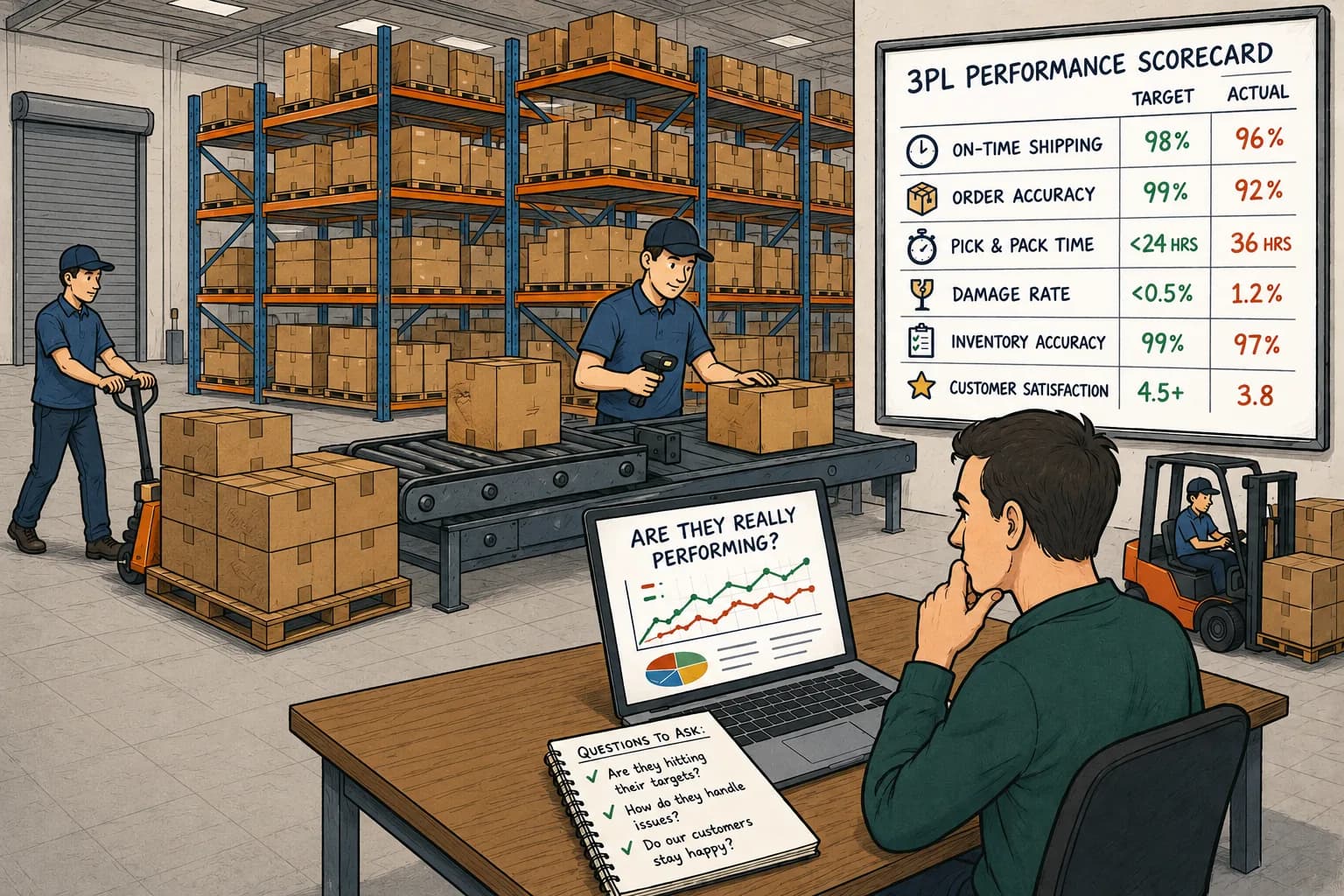
Order accuracy rate
This measures the percentage of orders shipped correctly, right item, right quantity, right address. Industry benchmarks typically sit above 99.5%, with best-in-class 3PLs hitting 99.9%+. If yours is consistently below 99%, that's a real problem, not a rounding error.
On-time shipping rate
This is the percentage of orders shipped within the promised window after an order is placed. Top-tier 3PLs generally target 98% or higher, though what counts as "on-time" should be defined in your contract. Be specific: does the clock start at order placement or at end-of-day cutoff? Ambiguity here is where disputes happen.
Inventory accuracy
Inventory accuracy compares what your 3PL's system says you have versus what's physically in the warehouse. Accuracy below 99% can lead to overselling, stockouts, and costly reconciliation work. This should be audited regularly, not just trusted at face value.
Perfect order rate
The perfect order rate measures orders that are shipped correctly, on time, complete, and without damage. It's a composite metric, and it's one of the clearest indicators of overall fulfillment health. A 3PL might score well on individual metrics but still produce a low perfect order rate if those failures cluster in the same orders.
Dock-to-stock time
This is how long it takes from when your inventory arrives at the warehouse to when it's available to ship. Best practice is within 24–48 hours for standard goods. Delays here create downstream order interruptions you may not even be tracking.
Cost per order
Cost per order includes pick-and-pack fees, storage, receiving, and any add-on charges. This metric matters for profitability, not just operations. If your cost per order is creeping up quarter over quarter without a corresponding volume decrease, find out why.
Returns processing time
How quickly are returns processed and restocked? In high-return categories, slow return processing ties up inventory and cash. Returns should typically be processed within 1–3 business days.
The problem with taking your 3PL's numbers at face value
Here's where things get interesting.
Jeff Uherek of GrowthSpoke put it plainly during a WareMatch interview: "I think a lot of 3PLs today stand on metrics alone. I can sit here and tell you that I've got a 99.99% accuracy rate and a 99.98% on-time rate. The reality is, we all do."
He's right. Any 3PL pitching you for business will show you their best numbers. What you actually need is data that's specific to your account, your volume, and your product type, not aggregate stats from across their entire client base.
This is why independent verification and context-specific benchmarking matter. Ask your 3PL to pull reports filtered to your account, not just platform-wide summaries. And look for trends over time, not snapshots.
Are they actually transparent with you?
Metrics aside, there's a simpler test: how do they communicate?
A 3PL that performs well will tell you when something goes wrong before you notice it yourself. They'll flag carrier delays proactively. They'll alert you to a receiving discrepancy the day it happens. They'll follow up after fixing a problem to confirm it's resolved.
A 3PL that underperforms often goes quiet. You find out about issues because customers complain first, or because you notice a spike in your own charge backs and support tickets.
SLA documents and contracts are only as good as the accountability behind them. Ask yourself honestly: do they answer the phone? Do they respond to emails within the same business day? When there's a problem, do they send a summary of what happened and what they changed to prevent it from happening again?
If you're chasing your 3PL for updates more often than they're reaching out to you, that's a communication problem, and it usually reflects broader operational issues.
Check your contract, then check whether it's being followed
If you have a formal contract or service level agreement (SLA) in place, go back and read it. A well-written SLA should define what "on-time delivery" means, set clear thresholds for order accuracy, outline how disputes are handled, and specify what happens if targets aren't met.
Then pull the actual performance data and compare.
If your 3PL is consistently missing contracted SLA thresholds, that's a breach of contract, not just a performance gap. And if you don't have formal SLAs in place, this is the right time to establish them. Define your expectations in writing. Make sure they're specific enough to be measurable.
If you're in the early stages of finding a 3PL, you should be asking about SLA structure during the RFP stage, not after you've signed a contract and onboarded your inventory.
The difference between a vendor and a partner
There's a meaningful difference between a 3PL that just processes your orders and one that's actually invested in helping your business grow.
Supply chain research from Ryder, published in Supply Chain Management Review, draws a clear line between transactional vendor relationships and genuine strategic partnerships. A strategic 3PL partner will flag cost-saving opportunities, suggest process changes as your volume scales, and treat your account's health as a shared concern.
A transactional 3PL will hit the contracted minimums and stop there.
Neither is automatically wrong for every business. If you're a small brand just getting started, a transactional arrangement might be all you need. But if your order volume is growing and your supply chain complexity is increasing, you want a 3PL that's paying attention to your business, not just processing tickets.
Signals that it's time to switch
Not every performance issue means you need to change providers. But some patterns are harder to fix than others.
Consider switching if:
Accuracy and on-time rates have been below threshold for multiple consecutive months
You've raised the same issues more than once and seen no lasting fix
Your cost per order has increased without a clear explanation
They've stopped proactively communicating and you're always the one following up
Metric trends are consistently declining quarter over quarter, even if current numbers are still "acceptable"
Their systems can't integrate with your Shopify, WMS, or analytics stack
A one-time problem can be forgiven. A pattern is data.
How to run a proper 3PL performance review
Set a cadence for reviewing your 3PL's performance, quarterly at minimum, monthly if your volume warrants it. During each review, look at:
Order accuracy rate for the period
On-time shipping rate versus your SLA threshold
Inventory accuracy (run a physical count or request a reconciliation report)
Perfect order rate
Cost per order versus previous period
Open support tickets and resolution times
Any incidents or exceptions, and how they were handled
Track these metrics over time, not just in isolation. A single month of 98.9% order accuracy might be acceptable. Three consecutive months of decline from 99.5% to 98.9% to 98.2% is a different story.
Finding a 3PL that actually performs
If you've gone through this process and realized your current 3PL isn't meeting the mark, the next step is finding one that will. That starts with comparing providers on the right criteria: not just price, but their SLA terms, technology stack, communication practices, and track record with businesses at your volume and product category.
WareMatch is a marketplace that connects e-commerce brands and SMBs with verified 3PL providers across the US. Rather than cold-calling warehouses or relying on referrals, you can browse providers, submit an RFQ, and receive competitive quotes from pre-vetted operators. Every listing includes service details, capacity information, and transparent pricing, so you can evaluate providers before you commit.
Whether you're reassessing your current setup or looking for your first 3PL partner, browse providers on WareMatch and find one that's actually built for your business.