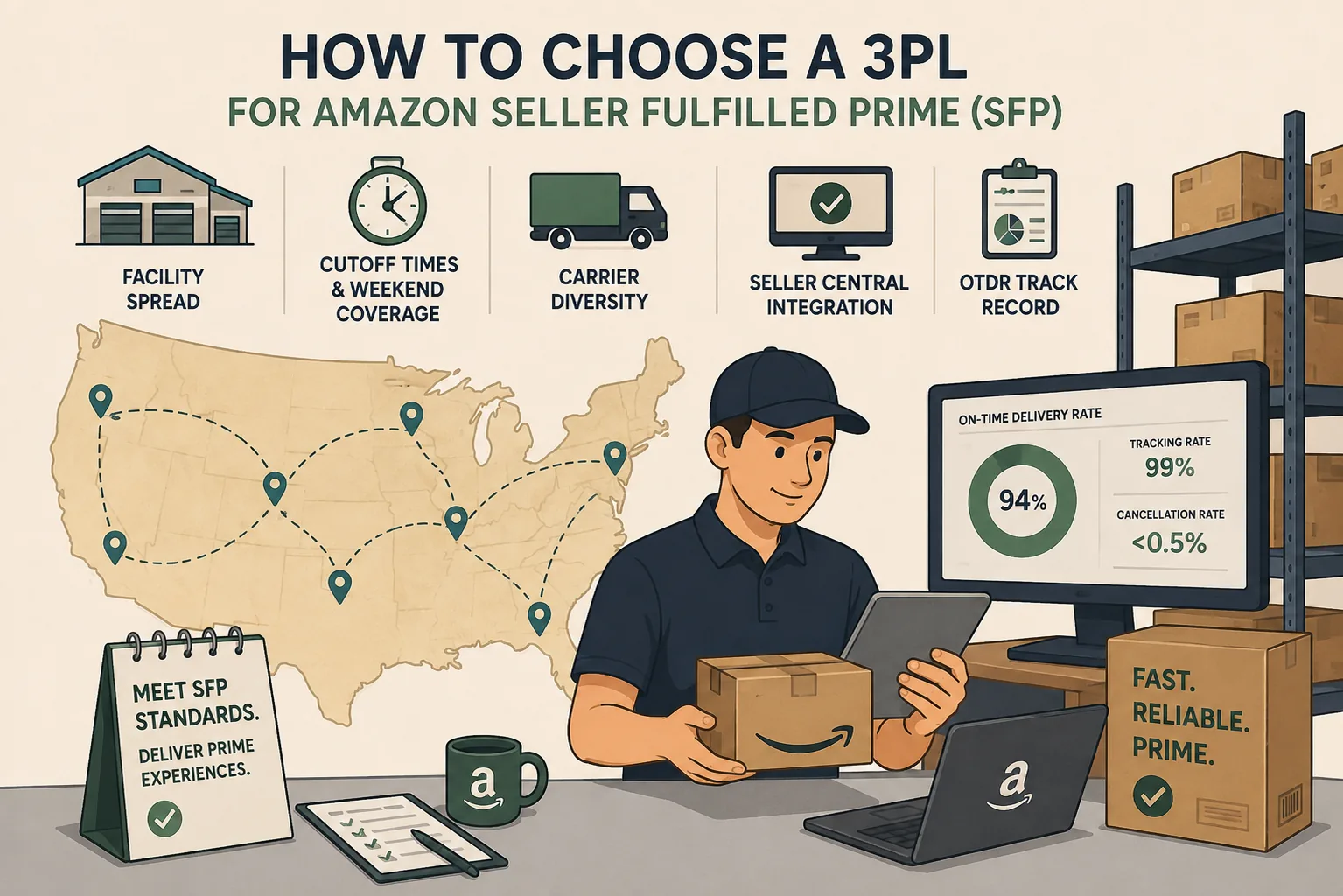
Vetting a 3PL for Seller Fulfilled Prime comes down to five things: facility spread across the country, order cutoff times and weekend coverage, carrier diversity, how fast tracking uploads to Seller Central, and whether the provider can show you a documented on-time delivery track record, not just a claim that they “support Amazon.” Most content that ranks for this topic is either a single 3PL's own sales page or a lead-gen listicle, neither of which gives you a way to compare providers against your actual requirements. The rest of this piece walks through what Amazon requires, why FBA experience alone doesn't qualify a 3PL for SFP, and the specific questions to ask before you start a trial period with a provider.
Why most SFP content won't help you pick a provider
Search “Seller Fulfilled Prime 3PL” and the results split into two categories. The first is individual 3PLs describing their own SFP service: their warehouse locations, their cutoff time, why their network qualifies. That's useful background, but it's a sales page, not a comparison. The second is lead-gen listicles that collect a form submission and promise to match you with a provider, without publishing the criteria behind the match.
Neither format answers the actual question, which is: does this specific 3PL's network, cutoff schedule, and delivery track record meet the SFP performance bar for the regions my customers are in? That requires comparing providers against a fixed set of criteria, which is what the rest of this guide sets up.
What Amazon actually requires, and why it's stricter than most sellers expect
Seller Fulfilled Prime isn't a one-time approval. Prequalification requires 100 or more seller-fulfilled packages in the trailing 90 days, a cancellation rate under 2.5%, a valid tracking rate above 95%, and a late shipment rate under 4%, using a Professional selling account with a domestic US ship-from address.
Passing prequalification gets you into a monitored trial, and the bar rises once you're through it: to keep the badge, Amazon's current maintenance thresholds require an on-time delivery rate above 93.5%, a valid tracking rate of 99%, and a cancellation rate under 0.5%, reviewed weekly.
That bar also isn't fixed. Amazon tightened the delivery-speed thresholds again on July 6, 2026, raising the one-day delivery benchmark from 30% to 40% of Prime page views, and the two-day benchmark from 70% to 75%. A 3PL that comfortably cleared last year's requirements can fall short of this year's without changing anything about how it operates, simply because the bar moved. If a provider can't tell you how their current network performs against today's thresholds, not last year's, that's a real gap, not a formality.
This is also, for background, the definition-level starting point: see WareMatch's glossary entry on Amazon SFP for the short version of how the program works.
FBA prep experience is not the same thing as SFP capability
This is the most common assumption that gets sellers into trouble: a 3PL that handles Amazon FBA prep, labeling, poly-bagging, and case-packing inventory for shipment into Amazon's own fulfillment centers, is not automatically equipped for SFP. FBA prep ends when the shipment leaves the 3PL's dock for an Amazon warehouse. SFP fulfillment is the opposite: the 3PL ships every order directly to the Prime customer, on Amazon's delivery-speed and tracking-accuracy schedule, indefinitely.
Some 3PLs run both services well. Others have built a strong FBA prep operation, providers like Datapak, for example, run FBA prep alongside multi-marketplace fulfillment, but that combination should be confirmed against the specific SFP metrics above, not assumed from the FBA prep listing alone. Ask any candidate directly what share of their current order volume is SFP versus FBA prep versus general FBM. If the honest answer is “mostly FBA prep, but we can do SFP,” treat that as a capability you're helping them build, not one you're buying.
The five criteria that actually matter when vetting an SFP 3PL
Facility spread and nationwide 2-day coverage
Amazon's requirement is national coverage, not regional. A single warehouse, wherever it sits, structurally limits how much of the country you can reach within a 2-day ground window. Ask how many facilities the provider operates, where they sit relative to population centers, and what percentage of US ZIP codes each facility reaches within 2-day ground shipping. A provider running two or three geographically spread locations can usually cover the vast majority of the country; a single-warehouse operation cannot, no matter how efficient that one warehouse is.
Cutoff times and weekend fulfillment
SFP requires operating at least one weekend day, with same-day handling for orders placed before a cutoff time no earlier than roughly 2pm on weekdays and mid-morning on weekends. Ask exactly what cutoff time the 3PL guarantees in writing, whether weekend fulfillment runs from every facility or just one, and what happens to an order that misses the cutoff. A verbal “we usually get it out same day” is not the same as a contracted cutoff time.
Carrier diversity, because OTDR reflects the carrier's performance, not just yours
On-time delivery rate is calculated against the carrier's actual delivery scan, not the 3PL's ship date. A provider relying on a single carrier is exposed to that carrier's regional service disruptions in a way a multi-carrier operation isn't. Ask which carriers the 3PL ships SFP orders through, and how they reroute volume when one carrier is running late in a given region.
Seller Central integration and tracking upload speed
A late tracking upload can register as a valid tracking rate miss even if the package shipped on time. Ask whether the provider's warehouse management system pushes tracking to Seller Central automatically at time of ship, or on a batch delay. For a brand also running Shopify or other channels alongside Amazon, this is the same integration-depth question covered in WareMatch's guide on finding a Shopify fulfillment partner, and it applies just as directly to multi-channel sellers evaluated through WareMatch's multi-channel fulfillment category, which lists meeting SFP cutoff times as a baseline capability, not an add-on.
How they handle a metric dip before it costs you the badge
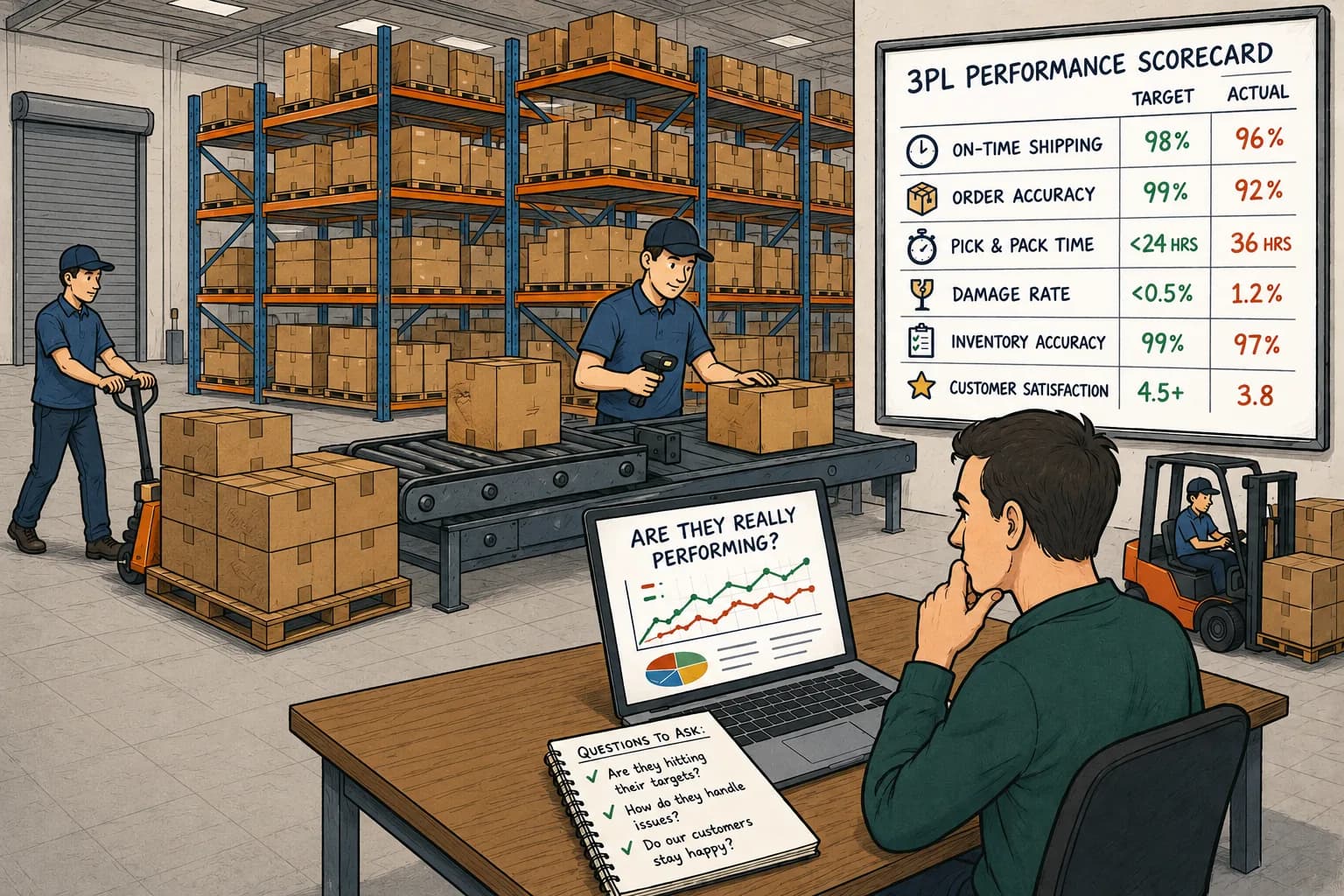
Every SFP operation has a bad week eventually, a carrier delay, a staffing gap, a spike in order volume the warehouse wasn't staffed for. What separates a 3PL worth using from one that isn't is whether they catch a metric slipping and correct it before it crosses Amazon's threshold, or whether you find out from an Amazon warning email. Ask what performance dashboard they give you, how often they review it against SFP thresholds specifically, and for an example of a time they caught and fixed a metric issue before it triggered a warning.
SFP, FBA, and FBM: the tradeoff in one paragraph
FBA hands Amazon your inventory and your delivery promise in exchange for storage and fulfillment fees that scale with size, weight, and storage duration. FBM with no Prime badge keeps full control but loses the conversion lift Prime eligibility gives a listing. SFP sits between the two: you keep inventory in your own or a 3PL's warehouse and keep control of cost structure, but you take on Amazon's delivery-performance requirements directly. WareMatch's guide on Amazon supply chain services versus a 3PL covers the broader FBA-versus-3PL decision in more depth; this piece assumes you've already decided SFP is the right model and are now choosing who runs it.
Why badge risk sits mostly with your fulfillment partner
Sellers tend to assume SFP performance is primarily about their own operations, order accuracy, inventory planning, customer service. In practice, once an order ships, on-time delivery is scored against the carrier's actual scan data, which means the delivery score reflects the carrier's performance more than the seller's, even when the seller shipped exactly on time. That risk sits with whichever 3PL is choosing the carrier and managing the route, not with the brand.
This isn't a new problem, either. Amazon has adjusted SFP enrollment before in ways that affected independent sellers directly: unredacted filings in the FTC's antitrust suit against Amazon showed the company had paused new SFP enrollments in 2019 despite sellers in the program meeting delivery reliability standards. The program's rules, and Amazon's posture toward it, can shift for reasons outside any individual seller's control. What is inside your control is who's running fulfillment underneath that shifting rulebook, and whether that partner has the network and monitoring in place to stay ahead of it.
Running the process
1. Write down your actual delivery footprint: where your customers are concentrated, and what 2-day ground coverage you need from a facility network to reach them.
2. Ask each candidate 3PL for their current, dated performance against the 93.5% OTDR / 99% VTR / 0.5% cancellation thresholds, not a general claim of “SFP experience.”
3. Confirm cutoff times, weekend coverage, and carrier mix in writing, not verbally.
4. Ask specifically what share of their business is FBA prep versus live SFP fulfillment, and for how long they've run SFP specifically.
5. If you're running other channels alongside Amazon, confirm the same provider can meet DTC or other channel-specific SLAs from the same facility network, rather than splitting inventory across separate 3PLs.
6. Compare more than one provider against these same criteria before starting a trial period. Switching mid-trial resets your clock; switching after a badge suspension costs you the badge itself.
That comparison step is the one a single 3PL's sales page or a lead-gen form can't give you, since you're only ever seeing what one company chose to show you. WareMatch's own breakdown of how the RFQ process works and how to read a 3PL quote cover the mechanics in more depth, but the short version:
submit one RFQ on WareMatch specifying SFP as a requirement, and you get quotes back from vetted providers matched to your actual delivery footprint, evaluated against the same criteria side by side.